20090602
Nowhere near the uncanny valley
20090531
A Better Place than Google Earth.
Shai Agassi, founder of Better Place, is well on his way to put internal combustion engines and coal power plants where they belong: in museums.
All that within the next two decades, mind you.
Best part of it is, it could actually work.
With a single eureka and a deployment plan that shows uncanny smarts for context analysis, the same man / company could be both the inventor, the initiator and the main agent of the most significant milestone to date on the way to green power and CO2 emission reduction.
The idea is simple: gas-powered cars are responsible for about 25% of the human-related CO2 emissions, but electric cars are plagued by their limited autonomy and the recharge time of today's batteries , not to mention their unfavorable cost of ownership.
Eureka.
Agassi's solution is to remove the battery from the end-user's side of the equation, and not for trolley wheels.
In the Better Place model, the killer app is gas stations equivalents that can swap the main electric battery of a car in the same time (or less) it takes to fill a tank of gas today, with less hassle for the user. Better even, by taking advantage of a car's downtime on the parking lot to recharge the batteries, these pit stops would be only occasional, and in any case less frequent than with a gasoline car.
Swapping the actual battery instead of recharging it is genuinely brilliant, largely because it's practical, provided the infrastructure allows the process to be fully automated, a plan that doesn't have to worry about backward compatibility or established providers slowing down the penetration of Better Place-compatible battery swap stations, because there is no competition yet.
Electric car owners don't have to front the cost of the batteries anymore, and re-pay it over time through the e-miles they're billed on battery swap (much like today's cell phones are sold below cost by telcos and repaid by the customer through her phone bills/minutes recharges).
Not only does this solution reduce the cost of acquisition and total cost of ownership for the customer while solving the autonomy issues, but it also enables all electric cars to seamlessly upgrade to the latest in batteries technology as those become available in power stations, further reducing the per-mile cost and environmental footprint of cars over time.
The required infrastructure may seem like a huge barrier to entry, until you realize building charge spots at home, on the workplace parking lot isn't such a big deal, since they're basically smart power outlets.
As for the much more innovative Battery Switch Stations, it definitely takes more heavy duty work, what with the cars on conveyor belts and the automated underside extraction/replacement of batteries in under 5', but I'd guess in these times of economic collapse, the extra jobs are welcome, and the real estate for that can be found at affordable prices, where simply converting existing gas stations is not an option.
Double-plus smart.
You would expect such a perfect plan to be instantly torpedo'ed by BigOil™ with all the weight they can put to milk the last of the gasoline profit until the world ends, right ?
That's where Agassi's business acumen really shines: after solving the practical issues on the wares front, he figured how to reach critical mass to force his way in by going for the most eager early adopter for anything that gets them out of OPEC and Iranian grip: Israel.
Then he moved on to the euro tree-huggers with their 100+ % taxes on gasoline and gas-powered cars, and to the third-worldish/developping countries that aren't too happy about spending their limited monies on Saudi oil when they could use homegrown electricity instead.
Australia, Canada, Japan are hopping on the bandwagon already, with many others to follow …well, pretty much any place gasoline is expensive and not locally produced in sufficient quantities to feed domestic needs can see the incentive in the model.
The US of A lag behind still, as usual when it comes to not entirely burning down the planet, yet the combo of Obama's green bent with a totally wrecked economy should steer Uncle Sam toward the clean electrons light sometime before people start shooting each other for jerrycans, Mad Max style.
Although there obviously are some bumps to iron out before the Better Place EV go global as intended, such as the big issue of actually feeding all those batteries with clean juice — lest eco-friendly EVs have to run on on dirty electrons from coal/diesel power plants — there is a good chance this model might work out: context has never been better for radical changes in the human transportation industry, and green is the new pink.
Where Google claims Do no evil as its motto (which is unrealistic, sounds a bit holier-than-thou and is largely disproved by the facts), Agassi takes a more radical and uplifting approach of not just dreaming the world was a Better Place.
My 2KW.
The enabler value of this project is not to be overlooked either: not only does it have the potential to single-handedly grow the market for clean electricity to critical mass, but it should make green juice available anywhere you have cars, which is also where consumer of electricity (for other purposes) hang out.
Once the infrastructure is there, and you can buy clean electrons right at home or at the corner shop for cheaper than the no-name current of your local utility company, both on tab and canned, the realm of possibles for creative/derivative applications (and lawsuits) is rather shweet.
Despite appeasing cookies thrown in the general direction of electric utility companies such as "Better Place’s services will also create an opportunity for utilities to utilize electricity produced from intermittent renewable energy sources more effectively (e.g., wind power generated at night).", it's pretty obvious where this is headed: the electrons route is about to become a two-way street as consumers awareness of electricity as a product (as in good/commodity) rises.
It's a recurring theme in Better Place's discourse that not all electrons are equal, depending on how they are produced, harvested, distributed and used.
With the green fad nowhere near ending, organic junkies will jump at the opportunity to switch to clean electrons for much more than powering their cars, as soon as convenience meets quality.
It won't be long after Better Place goes gold before homegrown and farmer-market styled electrons offers begin to flourish.
Will the utility companies cling on their crumbling monopolies, or embrace the change to get in business with local producers by offering to store and distribute their green juice ?
My guess is: both, and the former will go down lobbying and suing till they're blue in the face and get washed off.
The remaining ones will have to fight for their lives, by competing on retail price and/or perceived value (green is better, hence worth more) driving up the demand for affordable clean electrons.
I suspect Shai Agassi knows this already, but I can see clean electrons becoming an everyday alternative currency before 2030 if Better Place works out halfway as good as announced.
Meanwhile, I'd put my money in flywheels and efficient small scale water turbines if I had any (I'll leave as an exercise for the reader to work out what just crossed my mind, here).
20090521
Me luv Charlie.
He mans a very stimulating online diary, which he recently moved into a previously deserted domain of his: accelerando.org.
While announcing the relocation, he mentioned his Singularity ! A Tough Guide to the Rapture of the Nerds, which is not only funny as hell but also happens to be TiddlyWiki-powered.
Mom, I think I'm in love, I hope you'll understand.
PS: those stranded in Baltimore over this coming weekend (I know at least one who is) may find comfort knowing it's also where Charlie is (lolcat and stuff).
20090516
Operating system of me.
Being one of those people who are never entirely comfortable with certainty, and live with the nagging feeling that confidence is mostly about overlooking stuff — the paradox is only apparent — there isn't much I take for granted.
This list is intended as a helper resource for whoever decides to enter a discussion with me: if any of those seem too deeply flawed to you, you'll save us both time and frustration by first correcting me on those postulates you deem broken before you try to skin any other beast — either that or drop it.
Thanks.
- Less is (often) more.
- You can't un-fry things.
- Diversity is inherently desirable.
- The passing of time has no purpose.
- 90% of any human production is crud.
- A little knowledge is a dangerous thing.
- Convenience beats quality under most circumstances.
- The map is not the territory — don't get caught in metaphors.
- Hard work and steadfastness can't alone salvage flawed designs.
- Everything should be made as simple as possible, but no simpler.
- Those who most tend to seek power are less likely to exert it wisely.
- Our brains don't naturally grasp statistics, not even simple percentages.
- Never ascribe to malice that which is adequately explained by incompetence.
- Ideas should not be held responsible for the people who claim to defend them.
- It's unlikely there is a god… even more unlikely it cares in the least about you.
- Evolution is not a perfecting principle, it works on the just-good-enough principle.
- Concepts should not be judged based solely on the success or failure of their implementations.
- In most competitions, the optimal strategy is to hamper opponents' ability to compete whenever possible.
• These one-liners each ought to link to a full entry eventually, but as usual, don't hold your breath, this blog is a low-priority item as far as I'm concerned.
• Catchy zingers that happen to be corollary to any of the above have been purposefully omitted from this short list, and will be covered — if ever — in the full-entry versions.
Ex: I strongly support the notion that "Universal Suffrage is a scam", but it doesn't warrant an entry in the list above, as it is merely a corollary of several of other listed postulates (primarily but not limited to) "the optimal strategy in most competitions…", "convenience beats quality…", "A little knowledge is a dangerous thing." and "those who most tend to seek power…".
Ditto for: "Don't wait for your afterlife to make something of your time, there is no respawn for you noob."
20090430
On the way to Slate,
20090422
Steampunking the MacBook Pro…
Looking at Apple's specs, the operating ambient temperature range for these machines is 10°C to 35°C.
Needless to say, I routinely run my laptops on the high end of these temps, if not higher, which is a good enough reason to be concerned that those figures may not just be a matter of CYA on Apple's part.
Add to that the double issue of battery life and dust buildup inside the machine, both of which are tied to how often and how hard the two fans at the rear of the MacBook have to blow on the CPU/GPU heatpipes' heat exchangers, and it becomes obvious that anything which can be done to improve the cooling of this laptop by other means is a GoodThing™.
[Speaking of which, I'm not entirely sure how much of the air intake is done from the rear grille and how much is dependent on semi-improvised various holes such as around the keyboard, etc.]
Since I want to keep the drilling through the MacBook Pro chassis to a minimum of roughly zero (and it's not like there's much room to spare inside the box anyway), the back of the display casing seems like the best place to hook up some external cooling apparatus.
Yet before I even begin to worry about where the heck 'plate' type heatpipes can be procured, or how to build a small thermosyphon, I'll have to figure out the first and so very weak link in my thermal chain, ie: how to extract the heat from the 'cold end' of the factory heatpipes, and bring it to the 'hot end' of a back-of-the-display thermal circuit ?
The wiggle room between the internal heat pipe and the unibody shell is about 3 millimeters at best, and right next to the rear grille, so I figure a sheet of copper attached with clips and connected with thermal paste to the 'cold end' of the factory heatpipes can get me out of the chassis without sigificant adverse effects on the factory cooling system.
…yet from there I still need to work my way around the bottom of the display (which rests inconveniently below the topside plane of the main chassis) to reach the 'hot end' of the external heat dissipation circuit.
And no, hard plumbing is not an option, the display must still be able to open, adjust and close with the external cooling system mounted on, so the thermal bridge better be flexible.
Ideas ?
[See here for an in-depth look at the innards of the 17" MacBook Pro Unibody.]
Glaswegian Computing.
At first, I looked into heatpipes and/or thermosyphon based designs, but I recently stumbled on an old experiment, and it got me thinking.
Yes, at the uncanny crossroads of Scottish cuisine and Xtr3m3 nerdiness, people figured deep-fried computing was an operating concept, provided the tub is see-through.
Seriously, follow the link, I'll wait…
The quick and dirty cooking-oil-in-a-tub proven surprisingly solid, especially on the noise reduction end of things, which is kind of a big deal for me.
I also like the elegant simplicity of a pure convection liquid cooling system with zero pumps or extra power requirements.
The main limitations of the oil-immersion model (besides the yuck factor when adding extra RAM) seem to be the potentially harmful capacitance and corrosive characteristics of cooking oil, but provided a similar fluid without those drawbacks can be substituted, this approach has real potential.
Oil-like liquids, despite being less thermally efficient, are especially attractive as they don't evaporate as easily, which fits the general less is more angle I'm going for.
It would seem practical enough to build a kit based on a ready-made durable container, where the motherboard and PSU would be placed near the bottom, while everything that needs to remain easily user accessible such as drives and I/O connectors could be installed above 'sea level'.
Some passive funnels could also be mounted inside the cooling pool to boost the convection cycle.
Provided the side walls of the containers were made of acceptably transparent material, plexiglass style, and that two or more (non-soluble with each other) fluids of different densities could be found (that fit the conductive/capacitance/corrosion bill), a 3GHz lava-lamp becomes a distinct possibility.
Obviously the one big technical bump is finding the right fluid(s).
Any ideas ?
20081105
The mathematics of hatred.
From an empirical perspective, however, a solid argument can made that only a rough half of voters on any election vote in favor of something/someone, while the other half vote 'against'. That's enough to fuel the argument that majority rule sucks unwashed goats, yet also shines an interesting light on last night's election results.
Card-carrying members are taken for granted.
Just as with any other brand-pushing PR effort, more resources during a presidential campaign are devoted to bring in new supporters than to comfort the existing userbase, which naturally tends to reinforce itself when their beliefs are challenged.
Thus, campaign strategists go first and foremost for those undecided or uninvolved, and seek the fastest and cheapest way to bring them into the fold.
Why, oh why the hatred ?
A simple fact of a majority rule election is that it's really difficult to groom your own pony (no matter how good he/she may be) to look like a prize stallion in any possible voter's eyes.
Meanwhile, it's a reasonably trivial task to throw each and every accusation of awfulness you can muster (no matter how fictitious or far-fatched) in the general direction of the opposition and hope a little something will stick for everybody watching.
Ensuring a voice doesn't go to the other guy may not look as good as securing a vote for your own candidate, but it's at least half as beneficial when it comes down to the scoreboard: the worst that can happen is the voter is turned off badly enough by all parties that he/she simply doesn't vote at all, which is certainly better than him/her voting for the 'enemy'.
The more polarized the election, the stronger the case for this approach: when the game boils down to a duel, there's almost no apparent downside to smear tactics, since they can't result in outsider victories or kingmaker configurations.
From-the-hip probabiliguesses.
With this strategy as the default line of any strongly personalized campaign, one could expect the proportion of 'anti' voters to exceed that of 'pro' voters, but my guess is it's closer to a 50/50 split, as strongly polarized contests naturally tend to reinforce and freeze people in their preexisting biases, thus leading the 'positive' potential voters to opt in earlier and harder in favor of their candidate (than they would in a less intense election) which makes them largely impervious to the influence of smear tactics — either way.
Whether the final score is 50.1% vs 49.9% or 65% vs 35%, it is sensible to assume about half the votes on each side of the fence are cast in genuine support of their party's candidate/proposal, while the remaining half merely try to prevent a catastrophe by endorsing whichever candidate seems more likely to beat the one they don't want to see win the race.
[Caveat: This rule of thumb holds only within some limits of the scoreboard, however: the more extreme the final majority (from 70-30 up to 100-0), the higher the proportion of voters are likely to have cast a 'con' rather than 'pro' vote, and the more likely for the ballot result to simply mean: "This selection of choices is fubar, let's get the most scary stuff out of the way and run another, more sensible election, please ?"
This can be explained by an outlandish situation turning usually moderate people into temporary hardliners against the election configuration itself, rather than split over the choices divide.]
Speculating, one far-fetched idea at a time.
Obviously I have nothing to back this up to a reasonable certainty, my guesstimate roots in what I could gather over time from polls and talks over drinks with people of various political orientations (yeah, whoever they are for you, you can safely bet I'm all pally with your personal bad guys), but what I got from this thoroughly unscientific probing is nonetheless interesting.
Regardless of where the voters are on the political compass, or how polarized and ferociously fought the election is, each individual voter is just as likely to be motivated by genuine enthusiasm for "his" guy as he's to be only driven by a will to take down the opposition.
To clarify, the core values of one's personal political church are largely irrelevant to the proportion of 'positive' vs 'negative' voters in a group: obviously the farther out from the center one sits on the political spectrum, the more likely he/she is to be driven by hatred/fear of some 00ber ebil, be it soulless commies, vulture capitalists, christians, jews, muslims, atheists, fags, negroes, yni., and the main reason for people to niche into some extremist-yet-clearcut enclave is usually they're scared witless…
But that's not the nail I'm trying to hit here: extremist values certainly run on a hate/fear fuel mix, yet hardliners of any political group still can be separated between those who mainly idolize their leaders/candidates and those who mostly hate the guts of some specific political enemy/target/scapegoat, and when you take a bit of time to listen to them, both categories draw about equal numbers in the group.
So what ?
Well, by looking at this map, and in light of the 50/50 pro/con breakdown rule'o'thumb described above (assuming my hypothesis is of any merit), the spectacular victories achieved by either ticket in most states are telling a different story altogether.
The ballot scores on this presidential election sit in a 55-45 to 65-35 bracket, both in blue and red states, with few exceptions.
Using the 50/50 pro/con RoT, we can read about 30% of the voters in red states were strongly hostile to the Obama/Biden ticket, 30% were really favorable to the McCain/Palin ticket, while 20% of the voters were totally in the tank for Hopey/Joe-not-a-plumber, and another 20% hated McCain/Palin's collective guts.
Perfect symmetry in blue states, I'll spare electrons by not typing it.
Why half of the voters in each camp, boiling down to half of the total of voters would hate/fear the opposing ticket is left as an exercise for the reader, as the reasons are both plentiful and uncanny (for some at least), but one interpretation of the picture is that about 50% of the registered voters in any state each hate/fear the winning or losing ticket, and by extension, 40 to 60 percent of their fellow statemates.
On a national scale, the popular votes scores 52-46 at this writing , and it's a simple matter to extrapolate: 26% of the citizenry is ravished by Obama (hard to tell about Biden), and 23% just freak out about the idea of a commie-muslim-terroriss' nigger in the Oval Office, and plain want him dead.
Which could mean a healthy 49% sighed in collective relief (including John McCain) at the thought of Palin as president being no threat 'naymore — at least for now.
And yeah, because we're ugly cynics, we started a new betting pool on how long for some wacko to put a bullet in Hopey — predictions to be expressed in fractional values of a JFK term, obviously.
Enjoy the postponement of WW3, I know I do.
20081028
X-over 4 free 111
CodeWeavers' CEO seemingly blew a fuse a while back (around july '08) with the Great American Lame Duck Presidential Challenge, and then another a few days ago when some hiccup in the US of A high-velocity circling of the history drain sent the gas price at St Paul's pumps back down to $2.79.
End result: Crossover if offered for free (today) at CodeWeavers' website.
Does it look like a shameless plug to you ? It is, certainly, but in no way a shameful one in my view, as CrossOver is one of the best standalone WinXX emulators on the MacOS X platform (at least).
I'm a daily user of Parallel's Desktop for Mac, TransGaming's Cider (as it's the official platform for EVE Online's Mac 'client'), and CodeWeavers' Crossover (which, did I mention it, you can get for free today).
Objectively, Crossover smokes Cider on everything but audio, of which there is none at this writing: it doesn't crash nor pukes as much in the RAM, and most importantly for laptop users, doesn't attempt to melt your GPU the instant you launch a second client — and who plays EVE with less than two sessions, I ask you ?
There are obviously things you can't do with a WINE-styled WinXX emulator, compared to a machine-level emulation a-la Parallels Desktop, but when it comes to gaming, you can't beat the performance of Crossover, short of rebooting in native Windows mode — which is usually something I personally try to avoid.
So if you have a MacOS X machine, give it a spin, it's free as beer for one year if you jump at it today…
20081018
Don't trust the candyman…
As for AcDpad, I'm still waiting on the long overdue upgrade to run more than one instance of self concurrently so I have time to write here too, but I'm not losing hope entirely on plan B, which is merely me becoming fantastically smarter and more efficient at time management.
Don't hold your breath though, or don't sue me if you do.
20080913
Harpo and C°
Anyone who's been gravitating around MMO*, MUDs, MUSHes long enough has come to hate the MMOG/MMORPG acronyms with a passion, for a number of all very good reasons:
- Massive(ly) Multiplayer Online Role Playing Games is not a mouthful, it's the after-action of competitive eating (think what comes just after a bulimia attack).
- The Massive(ly) is an abomination to grammar, and we look retarded enough spending our lives playing games way past our prime as it is.
- The whole Game thing irks bearded academics and self-important hiveminds alike, not such a bad thing in itself, but kind of gets in the way of level-headed debate.
- Also, everybody thinks of WoW when you invoke MMO* (or Everquest, back last century) which further skews the discussion when you're talking about POWs-without-elves.
Persistent Online Worlds is self-explanatory, and while the multiplayer angle is only implicit, it's also obvious from a craft/business perspective: there's little benefit in creating a persistent universe on the intarwebs if it's not to share the experience, and the more the merrier.
R-POW encompass the games, but also social/business experimental worlds such as Second Life, as long as the users are expected to enter and stay in the world on their own volition and for the purpose of entertainment/fun/recreation. This remains true even if the experience actually sucks goats, is a painful grindfest, and a fraction of the population really aims at making a buck by farming gold, and is not there for fun and giggles.
E-POW (pronounced Hippo, obviously), are Educational, and can include many forms of Serious Games, such as those meant to raise awareness about political or social issues, teach history to kids and whatnot, as long as they fit the POW part of the bill and aren't just a Civ-like edutainment tool.
T-POW (teapot, pronounced Colbert-style), are Training POWs, typically military or specialty simulations meant to teach and hone practical skills (as opposed to support general education/information/debate on select issues). They can also include simulations designed to help businesses evaluate employees or build team spirit. Generally speaking, they differ from E-POW by being purposefully designed for a select audience and heavily goal-oriented.
With that out of the way, expect to see me maliciously sparkle future articles with both *-POW and MMO*, for variety's sake…
20080905
Fall update.
Namely, I've been goofing around with articles for the other blog, and reading like crazy, once again faced with the limitation of running a single instance on a linear 1 s/s time.
That said, I do sleep, and even dream. Thanks to one of the daily reads (I suspect), I woke up today with the vivid (albeit quickly vanishing) impression of a "perfect moment" kind of evening.
There was duck on the menu, but that's not key: I had the unrealistic privilege of sitting at the same table as Glenn Gould, Neal Stephenson and Will Wright, while Scott Adams was stuck in the elevator with Ayn Rand, to everyone else's relief (unfortunately, Charles Stross had missed his plane).
Unrelated, but the first episode of The Shield season 7 is out…
PS: Yeah, flight schedules are an insurmontable obstacle in my dreams, when death isn't, go figure…
20080425
I didn't take the week off.
For some reason, 6 days flew by since last post, and I have no idea where they went.
Subjective time flow here is really weird, and/or I can't seem to get the hang of it.
I've massed notes on design and world building, but I can't bring myself to post half-cocked rants, for some reason (believe that, previous entries aren't a fifth as bad the brain drool as they could have been without copy-editing) ...maybe I'm not blogger material after all.
Anyway, I'll play tease, be it only to guilt-trip myself into finishing those articles.
Coming Soon™ on this screen:
- Monica VS Phoebe: the dirt.
- MovieOS — Part II: The Bad.
- The other blog: because I can't post daily on one, why not make it worse ?
- Game making and the meaning of life: of the great why ? that keeps us awake at night.
ttyl.
20080419
20080418
Pentimento-free area.
A side effect is I've been looking back at already published posts more than once, and occasionally edited released content beyond mere spell checking and copy-proofing, which is probably a good thing on average, but it got me thinking about the abstraction layer of the blog template.
If I had a hard time writing here, up until I tweaked this blog template to an approximation of my taste, what does it say about reading it ?
I realize I'm using this platform as a poor man's (tiddly)wiki, because I'm lazy, and I can't help but try and emulate the organic nature of tiddler-based writing on a support that is meant as a fire-and-forget journaling platform.
Thus, I overdo on production value, revising the past as I go, which wouldn't be so much of a lie if it wasn't for the fact blogspot is conveniently (?) devoid of versioning and history.
A few months/years from now, will I be updating old entries to account for new developments ?
What of interface and cosmetic tweaks, could context change be enough to affect the meaning of old content ?
Does it matter ? In any way ?
Guess that's what the Brainfart label is for.
Cooking made easy.
Reminder ?
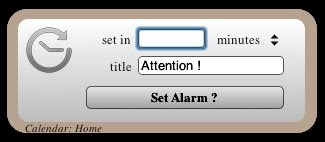
Reminder is a Dashboard Widget that took me some time to find, and which I've been depending on ever since, for everything from cooking to calling people back, to keeping the infamous *just 5 minutes* computer-time warp in check.
What it does is deceptively simple: create iCal events (complete with alarms) in the future with minimal keypresses and interface fiddling.
Usage:
Summon Dashboard, and if you — like me — leave Reminder on as your last/default text input, all you need is to type the number of minutes until the event, optionally hit Tab once to edit the name of the alarm, and press Return or Enter before you resume normal activity.Time units can be toggled to hours or days prior to digit input, by hitting the h or d key first. Beautiful in simplicity.
Notes:
This is one of those *basic* tools I'm confident no MovieOS designer could overlook, yet is consistently absent from RealWorld™ vanilla OS distros.In fact, before CASE Apps became Gravity Apps, their slogan was:
Applications that should have been in the box.Spot on.
Their other stuff is nice, too — I'd buy Steel in a blink if it was cross-platform, but I'm still entangled to good ole S3's PasswordWallet, for compatibility reasons.
As a final note, it's worth mentioning what a nice chap Martin Kahr is:
Back in 2006, when Reminder 1.x was still Rem!nder, published by CASE Apps, I had problems getting it to work reliably on my tuned version of Panther (notably using case-sensitive FS), and Martin whipped a custom build overnight that fixed it and got me running up to the 2.0 release (Leopard friendly).
Tip'o'the hat, that's solid freeware support.
20080417
Zulu Time 4tw !
One would argue having hours all fuzzy and mixed up around the clock has a redeeming value, would it contribute to raise awareness about the notion that time is not, in fact, a constant and frozen dimension, but c'mon: grab anyone at random in the street — not on campus, you cheater ! — and ask them how switching the clock forward one hour every spring makes them feel about their LightCone.
Chances are the answer will be something akin to "Huh ?", or "Go away, you pervert !", depending on gender/age differences between the guinea pig and yourself.
Not only are Timezones stupid in essence, when no one sets their clock by sundials anymore, but they are botched beyond repair. Check the map, and tell me if it makes sense to you...
As national borders erode in favor of continental (global) and regional (local) spatial references, clinging on a literal translation of sovereignty from map to clock is about as relevant as the defense of flat earth theory, or the selection of rulers based on physical prowess.
...hold the presses, does "best hair" count as physical prowess ?
Moving on.
Zulu to the rescue.
That's an easy fix: let's all switch once and for good to Zulu, GMT, UTC, UT1, TAI, however you want to call it, and be done with that.No matter where you go, then you are: no more clock fiddling, local time confusion, longitudinal discrepancies over nonsensically expanded/shrunk timezones. US east-coasters would have diner around 23.00h, just like they do now, only their clocks won't be blinking stupidly on 6 PM anymore, and it will still be about breakfast time in Osaka, just like today.
[And yes, we would take the opportunity to get rid of the dumbalicious AM/PM notation, as it really, really wouldn't mean squat anymore.]
If people can adjust to DST twice a year — a change just big enough to be unsettling for a couple weeks every time it happens — odds are pretty good they can adjust to a one-time, however severe change of display on their wristwatches.
Maybe the transition could be helped by going for dual-display of *old* and *new* time, while I suspect it could be more a drag than anything.
Alternatively, clocks could be upgraded with a fourth hand, coupled with geolocation, that would point solar noon for your current locale, and give a feel for one's "when" in the day.
That would be cute, and sell a lot of wristwatches, gotta love it.
[If someone knows how to hack a google gadget for that, eternal love shall ensue.]
Why UTC and not InternetTime ?
Short answer: because Swatch's iNet Time is a proprietary time.Long answer: because Swatch Internet Time is just as ridiculously stupefid as the short answer above hints.
- It's locked on Biel, Switzerland (no kidding), and not even accurate at that ;
- It substitutes an arbitrary unit everybody is used to for another no one will get used to, as it doesn't fucking divide (because-we-can type of design flaw) ;
- who wants to to mesure 2.31481481481 friggin beats to properly cook an oeuf à la coque, anyways ?
Wrapping up
Zulu is good because it's already a standard for time-critical applications, like airlines, high-sea navigation, and basically anything that has a non-cosmetic use for timekeeping.Also, most people who routinely relate or travel to distant locales are already up to speed on their relative position to UTC.
As an ancillary benefit, coming to agree on giving each other the time of the day could be a nice first step towards acknowledging we're all more or less on the same boat.
Holy Carpaccio, Melissa: how campy can I get with punchlines ?
Ball-point ride.

but this thing still makes for some cute future shock.
[PS: free cookies for anyone who can tell me how to avoid borders on pictures.]
[PPS: Found it ! Free cookies for meh.]
MovieOS — Part I: The Good.
In fact, it's probably one of the best hopes for the otherwise sclerotic field of computer user interfaces to ever improve.
This is Part 1/3 of a short series about the relevance of MovieOS to designers.
Links to Parts 2 and 3 tba.
For those who are behind on their nerd jargon, MovieOS is the umbrella porte-manteau blanket label (picture this !) that applies to the peculiar logic ruling over all things computing, and notably user interfaces, as depicted in movies and TV shows.
Why you shouldn't hate MovieOS.
MovieOS is generally blamed by the Anal Nerd Squad for its lack of "realism" and technical soundness, in view of what is deemed CommonSense™ about computers and user interfaces.It says more about the lack of imagination and insecurities of computer nerds than anything, except maybe for their cluelessness about story telling.
MovieOS generally does its job, which is that of a prop or plot device, meant to tell us somehing and further the story line.
As a believable operating system and user interface, it is usually out of touch with the state of affairs in RealWorld™ computing, and that's exactly why it's interesting to this armchair designer.
What MovieOS can do for us, already.
User interfaces, like all things human, are the product of their history, and it shows.To this day, even though the available memory, computational and rendering power of most computers and appliances exceeds by far the requirements of spartan implementation, we're generally stuck with interfaces that say a lot about their ancestors and about the culture of the nerds and marketing drones who botched them, yet have little relation to what the user intends to do with the software/hardware, nor how she'd like to do it.
MovieOS, on the contrary is all about the user intent, purposes and ways: its form is supposed to let us know all we need to learn about function, because it is mainly through MovieOS that we will experience the impact of the protoganist's actions on the computer/traffic light/giant combat cyber-bunny.
So... MovieOS is all about usability, with iconic representations, symbols and metaphors which anybody in the audience can relate to and intuitively grasp.
...yeah, that's pretty much what you'd expect from a good OS/GUI.
— Except *in reality* computers don't work that way ! (object the 1337 nerds)Precisely that which irritates the ANS is what makes MovieOS a great bootstrap for reflexion on user interface: it's designed "backwards".
— Guess what ? It's a damn shame they don't, for the most part. (counters I)
Let's dive in...
What MovieOS can do for us, almost.
A frequent objection to MovieOS is how it often performs seemingly impossible/ludicrous feats, like infinite image enhancement from a grainy CCTV/satellite shot.Without pulling the Advanced Technology≈Magic joker card, we already have software that can provide us with results of seemingly finer granularity than the sample item provided as user-level reference.
While the classic "magic endless zoom" of Hollywood movies may be overreaching, what is within reach already (in some areas), is the possibility to pull pinpoint geolocation for a target from a satellite shot, and poll all relevant CCTV data from the immediate surroundings and timestamp.
If we assume streaming video pooled from multiple angles, even at low res, we end up with a solid base material to build a full 3D image, possibly in higher resolution (interpolated) than that of any individual witness camera.
With SmartDust sprayed in the wild or embedded in wall paint, no place is safe from such visual recompositions.
For a nice example, of SciFi-grade tech turned RealWorld™ product overnight, check this.
Another of the archetypal fallacies pointed by its detractors is MovieOS apparent predictive capabilities:
— How comes the M-I laptop knows in advance Tom will need to bring up a satellite view of that specific area in Chile, to have it at the ready just on cue ?In some ways, MovieOS bashers, for all their technical superiority posturing, are just like 5 year old kids who can't help themselves and yell at the actors on the screen: Watch out ! He's behind you !
— Because there *is* a cue: It's scripted, stupid !
Because we can tell from MovieOS display what the protagonist just did, that's clue enough for us to guess her likely next moves, one of which will be confirmed by MovieOS eye-candied display.
Believe it or not, it's not too hard for a contemporary expert system to guess, either.
It's not a walk in the park, but provided enough background and context, it's not far-fetched to imagine automated systems making educated guesses, or responding fast enough to complex situations to seem like they anticipate.
For a RealWorld™, relatively mundane example, see trajectory correction, anti-spin/drift and electronic gear shifting systems on high-end cars: some of those rides would make you think they actually use the onboard GPS to tell the next curb in advance (they don't), and notice the pavement is wet and slippery before you did (they do).
Give an expert system enough history about your typical behavior, some good heuristics to turn that into meaningful context, keep it available as a portable/ubiquitous and non-obtrusive resource, and you got yourself an OS that will be one steap ahead of you 80% of the time.
Before anyone gets shot: no, Microsoft Office Assistants and various Wizards are not a step in that direction (because they ask you too many questions, too early, in a context with too many options in the decision tree anyhow), but the "recently used items" in Windows™ Start Menu are.
Wrapping up the goods.
Not encumbered by the software designer's set of aesthetics prejudices, moviemakers certainly overlook a number of technical objections, and generally make horrible mistakes, but no one among the large number of me is saying we should use MovieOS as a literal blueprint for an OS/GUI (although I'm a huge fan of Galaxy Quest).Instead, we should see MovieOS for what it can be to us, a strong source of inspiration for usability, as it gives us a hint of how people who aren't software designers — yet know a thing or two about getting a message across — imagine what an OS/GUI should look like for a given application, and how it should perform.
Those of us willing to break the ranks of the Anal Nerd Squad and look beyond the superficial (and irritating) misrepresentation of hacking and engineering may realize this kind of fantasy tech data can be mined for gold.
[To be continued in Part II: The Bad.]
MovieOS
Summarily, MovieOS combines:
- infinitely interoperable hardware/software (you can plug everything into anything, sockets match and much succesful handshaking ensues) ;
- seemingly limitless computational and rendering power (sound and image can be enhanced to crystal precision from the crappiest original image/recording) ;
- psychic-grade usability (a couple of neatly placed obvious pads/buttons activate just the function you need next, regardless of how unlikely it is for you to summon an Instant Satellite Hijack wizard in the middle of perusing the Online Traditional Thai Cookbook) ;
- ubiquitous interconnection (you have link anywhere, unless the plot requires you don't, and the webcam in your backyard dog-house not only has X-ray and thermal modes, but is direct linked to NSA surveillance grid, and to every soda vending machine in South Africa) ;
- GUI that come in three main variations, possibly mixed together, (1-DEU mode) visual -impaired, size 72 clear-on-dark glowing text and full-screen zooming kindergarten-themed icons, (2-Xpert M0de) manyfold-plentiful fast-scrolling lines of tiny blinking text filling the screen, (3-4L1EN Mode) 3-D floating glyphs resolving through smokey/watery effects, Jaron Lanier phant'sy ;
- quantum computing, or something similarly magic, is implied by the ability to reconfigure any piece of hardware into almost anything (including nuclear grade power source/weapon) by mere fiddling of the software ;
- obviously MovieOS doesn't crash or bug out, yet is susceptible to advanced malware, notably video-enhanced virri.
.jpg)